df.tail()| km | area | 2 | 4 | 10 | 20 | |
|---|---|---|---|---|---|---|
| 215 | 180 | 沖縄 | 38480 | 44990 | 59890 | 77070 |
| 216 | 190 | 沖縄 | 40010 | 46770 | 62270 | 80170 |
| 217 | 200 | 沖縄 | 41540 | 48540 | 64660 | 83280 |
| 218 | 210 | 沖縄 | 3050 | 3530 | 4700 | 6110 |
| 219 | 220 | 沖縄 | 7610 | 8810 | 11740 | 15270 |
2021(2024)年から施行された標準料金を読み込み,pickleに保管しておく.
df.tail()| km | area | 2 | 4 | 10 | 20 | |
|---|---|---|---|---|---|---|
| 215 | 180 | 沖縄 | 38480 | 44990 | 59890 | 77070 |
| 216 | 190 | 沖縄 | 40010 | 46770 | 62270 | 80170 |
| 217 | 200 | 沖縄 | 41540 | 48540 | 64660 | 83280 |
| 218 | 210 | 沖縄 | 3050 | 3530 | 4700 | 6110 |
| 219 | 220 | 沖縄 | 7610 | 8810 | 11740 | 15270 |
def simple_cycles2(G, limit):
    subG = type(G)(G.edges())
    sccs = list(nx.strongly_connected_components(subG))
    while sccs:
        scc = sccs.pop()
        startnode = scc.pop()
        path = [startnode]
        blocked = set()
        blocked.add(startnode)
        stack = [(startnode, list(subG[startnode]))]

        while stack:
            thisnode, nbrs = stack[-1]

            if nbrs and len(path) < limit:
                nextnode = nbrs.pop()
                if nextnode == startnode:
                    yield path[:]
                elif nextnode not in blocked:
                    path.append(nextnode)
                    stack.append((nextnode, list(subG[nextnode])))
                    blocked.add(nextnode)
                    continue
            if not nbrs or len(path) >= limit:
                blocked.remove(thisnode)
                stack.pop()
                path.pop()
        subG.remove_node(startnode)
        H = subG.subgraph(scc)
        sccs.extend(list(nx.strongly_connected_components(H)))
dem = od_df.SHASHU_SAIDAISEKISAIRYO_CD_1.astype(int, errors="ignore")
dem.hist()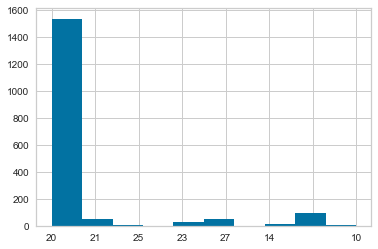
#中継地点の描画
#地点名も出すようにする!
data =[go.Scattermapbox(
        lat=lat_head,
        lon=lon_head,
        marker = {'size': num},
        hoverinfo='text',
        hovertext= head,
        text= head,
        mode="markers",
        name="車庫"
    )]
data.append(
    go.Scattermapbox(
        lat=lat_switch,
        lon=lon_switch,
        marker = {'size': 5},
        hoverinfo='text',
        text= switch,
        mode="markers",
        name="中継地点"
    )
)
fig = go.Figure(data=data, layout=layout)
plotly.offline.plot(fig);ロジスティックネットワーク設計問題を例として,データの前処理やクラスタリングの方法による違いを調べる.
まずはデータを読み込む.列名はSCMOPTにあわせて変えておく.
cust_df = pd.read_csv(folder+ "Cust.csv")
cust_df.columns= ["name","lat","lon"]
cust_df["lat"] = cust_df["lat"].astype(float)
cust_df["lon"] = cust_df["lon"].astype(float)
#cust_df.head()
#可視化で確認
fig = plot_cust(cust_df)
plotly.offline.plot(fig);total_demand_df = pd.read_csv(folder+ "Cust-Prod.csv")
total_demand_df.columns=["cust","prod","demand"]
#total_demand_df.head()dc_df = pd.read_csv(folder+ "DC.csv")
dc_df.columns=["name","fc","vc","lb","ub","lat","lon"]
dc_df.lb = 0.
#dc_df.head()plnt_df = pd.read_csv(folder+ "Plnt.csv")
plnt_df.columns=["name","lat","lon"]
#plnt_df.head()prod_df = pd.read_csv(folder+ "Prod.csv")
prod_df.columns=["name","weight"]
#prod_dfplnt_prod_df = pd.read_csv(folder+"Plnt-Prod.csv")
plnt_prod_df.columns=["plnt","prod","ub"]
#plnt_prod_df.head()同じ緯度・経度をもつ地点が多数存在する.これは,K-d木を用いると容易に確認できる. ここでは,そのままのデータで解くが,k-メディアン法は,同じ地点があると2つともクラスターの中心(メディアン)として選択してしまうので,注意を要する.
df = enumerate_near_points(cust_df, 0.0001)
#dfdurations, distances, node_df = compute_durations(cust_df, plnt_df)#ネットワーク生成
trans_df, graph, position = make_network_using_road(cust_df, dc_df, plnt_df, durations, distances, plnt_dc_threshold = 10000., dc_cust_threshold = 200. )
# 大圏距離で代用する場合には,以下を生かす
#trans_df, graph, position = make_network(cust_df, dc_df, plnt_df, plnt_dc_threshold = 10000., dc_cust_threshold = 500. )需要の分布を確認すると,ほとんどが2000以下なので,除外する. 0の需要だけを除外した場合は,数値のばらつきがあまりにも大きいために,Gurobiでさえ不安定になり,解くことができない(もしくは非常に時間がかかる).
fig = px.histogram(total_demand_df,"demand")
plotly.offline.plot(fig);
total_demand_df = total_demand_df[ total_demand_df.demand >= 2000. ]これで773点の問題例が,約300点になった.
print(len(cust_df))
cust_df = remove_zero_total_demand(total_demand_df, cust_df)
print(len(cust_df))
773
299flow_df, dc_df, cost_df, violation_df, status = solve_lnd(prod_df, cust_df, dc_df, plnt_df, plnt_prod_df, total_demand_df,
trans_df, dc_num= (5,13), single_sourcing=True, max_cpu = 100)cost_df| cost | value | |
|---|---|---|
| 0 | transportation (plant to dc) | 9.736955e+08 |
| 1 | delivey (dc to customer) | 3.606422e+08 |
| 2 | dc fixed | -0.000000e+00 |
| 3 | dc variable | 6.524372e+08 |
| 4 | infeasible penalty | 0.000000e+00 |
#費用の可視化
fig = px.bar(cost_df, y="cost", x="value", orientation='h')
plotly.offline.plot(fig);cost_df.value.sum()1986774926.5981956fig = show_optimized_network(cust_df, dc_df, plnt_df, prod_df, flow_df, position)
plotly.offline.plot(fig);データを読み直して,地点間の移動時間を計算した後で,クラスタリングを行いデータを集約する.
最適化後に,非集約し,本当の配送費用を計算する.
まずは,階層的クラスタリング法を適用する.これは,道路距離と時間を用いる.
#clusterning
weight_of_prod ={p:w for (p,w) in zip(prod_df.name, prod_df.weight) } #prepare weight dic.
weight_of_cust = defaultdict(int)
for row in total_demand_df.itertuples():
    weight_of_cust[row.cust] += weight_of_prod[row.prod]*row.demand
weight = [weight_of_cust[i] for i in weight_of_cust]
durations, distances, node_df = compute_durations(cust_df, None)
fig = elbow_method(cust_df, weight, n_lb = 3, n_ub = 60, repetitions=1, method="hierarchical", durations=durations)
plotly.offline.plot(fig);X, Y, partition, cost = hierarchical_clusterning(cust_df, weight, durations, num_of_facilities = 50, linkage="complete")
print(cost)382277301752.6439fig = show_optimized_continuous_network(cust_df, X, Y, partition, weight= weight)
plotly.offline.plot(fig);aggregated_cust_df, aggregated_total_demand_df = make_aggregated_df(cust_df, None, total_demand_df, X, Y, partition, weight)
aggregated_dc_df = generate_dc(aggregated_cust_df, aggregated_total_demand_df, prod_df, num_dc=10, lb_ratio=0.0, ub_ratio=10.3,vc_bounds=(19,21),fc_bounds=(0,1))
durations, distances, node_df = compute_durations(aggregated_cust_df, plnt_df)
aggregated_trans_df, graph, position = make_network_using_road(aggregated_cust_df, aggregated_dc_df, plnt_df, durations, distances, plnt_dc_threshold = 10000., dc_cust_threshold = 500. )
flow_df, dc_df, cost_df, violation_df, status = solve_lnd(prod_df, aggregated_cust_df,aggregated_dc_df, plnt_df, plnt_prod_df, aggregated_total_demand_df,
aggregated_trans_df, dc_num= (5,13), single_sourcing=False, max_cpu = 100)fig = show_optimized_network(aggregated_cust_df, aggregated_dc_df, plnt_df, prod_df, flow_df, position)
plotly.offline.plot(fig);cost_df| cost | value | |
|---|---|---|
| 0 | transportation (plant to dc) | 9.761203e+08 |
| 1 | delivey (dc to customer) | 2.418022e+08 |
| 2 | dc fixed | -0.000000e+00 |
| 3 | dc variable | 6.505497e+08 |
| 4 | infeasible penalty | 0.000000e+00 |
上の費用のうち,顧客への配送費用は,集約した点に対するものなので,本来の費用ではない.本来の費用を再計算する.
# Single Source を仮定
from_dc = {} #集約した顧客に入る倉庫の名称を入れた辞書(集約した顧客名をキーとする)
for row in flow_df.itertuples():
if row.to_node[:5]=="Cust_":
from_dc[row.to_node[5:]] = row.from_node[3:]
#開設した集約倉庫に最も近い顧客を探索
from scipy.spatial import KDTree
points = [(i,j) for (i,j) in zip(cust_df.lat, cust_df.lon)]
tree = KDTree(points)
dc_cust_dic={} #集約した倉庫の名前を入れると,それに最も近い,もとの顧客indexを返す辞書
for row in dc_df[ dc_df.open_close==1 ].itertuples():
dis, near = tree.query( (row.lat, row.lon) )
dc_cust_dic[row.name] = cust_df.loc[int(near),"index"]
durations, distances, node_df = compute_durations(cust_df, None)
#dc_set = set(from_dc.values()) #from_dc: 各集約顧客が,どのDCから来ているかを表す辞書
#agg_cust_set = set(from_dc.keys())
dc_per_dis = 10./4000
dc_per_time = 8000./4000
total_del = 0.
for row in aggregated_cust_df.itertuples():
dc_name = from_dc[row.name]
#print(dc_name, row.name)
i = dc_cust_dic[dc_name]
for c in row.customers:
j = cust_df.loc[c,"index"]
if distances[i][j] < 9999999:
dis = distances[i][j]/1000.
time = durations[i][j]/3600.
cost_per_kg = dis*dc_per_dis + time*dc_per_time
total_del += weight[j]*cost_per_kg
total_del436088454.2303338配送費用は,クラスタリングした場合より大きくなり,総費用は以下のように増加する. これは,需要が2000未満のものを削除して最適化した場合の1.4%増であり,良い近似になっていると考えられる.
total = cost_df.value[0] + cost_df.value[3] + total_del
print(total, total/1986774926)2020658919.3316379 1.0170547719765404k-median法で集約する k-メディアン法も道路距離と移動時間をもとに計算を行う.同じ座標の地点があると,何も割り当てられないクラスターができることがあるので,多少多めに(この場合は1つ多く)施設数を入れておく.
durations, distances, node_df = compute_durations(cust_df, None)X, Y, partition, best_ub, lb_list, ub_list, phi_list = solve_k_median(cust_df, weight, durations, num_of_facilities=51,
max_iter=10000, max_lr=0.01, moms=(0.85,0.95), convergence=1e-5, lr_find = True, adam=False)fig = plot_k_median_lr_find(phi_list, lb_list)
plotly.offline.plot(fig);
#lr_finder => 0.01 , adam => 50000X, Y, partition, best_ub, lb_list, ub_list, phi_list = solve_k_median(cust_df, weight, durations, num_of_facilities=51,
max_iter=2000, max_lr=0.05, moms=(0.85,0.95), convergence=1e-5, lr_find = False, adam=False)fig = plot_k_median(lb_list, ub_list)
plotly.offline.plot(fig);fig = show_optimized_continuous_network(cust_df, X, Y, partition, weight= weight)
plotly.offline.plot(fig);aggregated_cust_df, aggregated_total_demand_df = make_aggregated_df(cust_df, None, total_demand_df, X, Y, partition, weight)
aggregated_dc_df = generate_dc(aggregated_cust_df, aggregated_total_demand_df, prod_df, num_dc=10, lb_ratio=0.0, ub_ratio=10.3,vc_bounds=(19,21),fc_bounds=(0,1))
durations, distances, node_df = compute_durations(aggregated_cust_df, plnt_df)
trans_df, graph, position = make_network_using_road(aggregated_cust_df, aggregated_dc_df, plnt_df, durations, distances, plnt_dc_threshold = 10000., dc_cust_threshold = 500. )
flow_df, dc_df, cost_df, violation_df, status = solve_lnd(prod_df, aggregated_cust_df,aggregated_dc_df, plnt_df, plnt_prod_df, aggregated_total_demand_df,
trans_df, dc_num= (5,13), single_sourcing=True, max_cpu = 100)cost_df| cost | value | |
|---|---|---|
| 0 | transportation (plant to dc) | 9.647053e+08 |
| 1 | delivey (dc to customer) | 2.503247e+08 |
| 2 | dc fixed | -0.000000e+00 |
| 3 | dc variable | 6.269581e+08 |
| 4 | infeasible penalty | -0.000000e+00 |
fig = show_optimized_network(aggregated_cust_df, aggregated_dc_df, plnt_df, prod_df, flow_df, position)
plotly.offline.plot(fig);aggregated_cust_df.head()| name | lat | lon | customers | demand | |
|---|---|---|---|---|---|
| 0 | cust0 | 34.577843 | 135.438274 | [51, 112, 125, 151, 152, 206, 256, 265, 266, 267, 270, 285] | 8.997956e+06 |
| 1 | cust1 | 41.826084 | 140.725339 | [1] | 1.824079e+06 |
| 2 | cust2 | 36.031805 | 139.630817 | [2, 15, 64, 81, 85, 129, 238, 293] | 4.023094e+06 |
| 3 | cust3 | 34.674853 | 135.634251 | [8, 35, 82, 86, 103, 104, 120, 150, 259, 264] | 8.146061e+06 |
| 4 | cust4 | 35.982864 | 139.860838 | [11, 68, 77, 154, 174, 182, 260, 275, 287] | 6.499158e+06 |
# Single Source を仮定
try:
cust_df.reset_index(inplace=True)
except:
pass
from_dc = {} #集約した顧客に入る倉庫の名称を入れた辞書(集約した顧客名をキーとする)
for row in flow_df.itertuples():
if row.to_node[:5]=="Cust_":
from_dc[row.to_node[5:]] = row.from_node[3:]
#開設した集約倉庫に最も近い顧客を探索
from scipy.spatial import KDTree
points = [(i,j) for (i,j) in zip(cust_df.lat, cust_df.lon)]
tree = KDTree(points)
dc_cust_dic={} #集約した倉庫の名前を入れると,それに最も近い,もとの顧客indexを返す辞書
for row in dc_df[ dc_df.open_close==1 ].itertuples():
dis, near = tree.query( (row.lat, row.lon) )
dc_cust_dic[row.name] = cust_df.loc[int(near),"index"]
durations, distances, node_df = compute_durations(cust_df, None)
#dc_set = set(from_dc.values()) #from_dc: 各集約顧客が,どのDCから来ているかを表す辞書
#agg_cust_set = set(from_dc.keys())
dc_per_dis = 10./4000
dc_per_time = 8000./4000
total_del = 0.
for row in aggregated_cust_df.itertuples():
try:
dc_name = from_dc[row.name]
except:
continue
i = dc_cust_dic[dc_name]
for c in row.customers:
j = cust_df.loc[c,"index"]
if distances[i][j] < 9999999:
dis = distances[i][j]/1000.
time = durations[i][j]/3600.
cost_per_kg = dis*dc_per_dis + time*dc_per_time
total_del += weight[j]*cost_per_kg
total_del429417810.7833409cost_df.value[0] + cost_df.value[3] + total_del2021081255.65393542005167825/19867749261.0092576661600168k-means法は重心法ともよばれ,座標をもとに平面上の適当な地点に施設を配置する.
weight_of_prod ={p:w for (p,w) in zip(prod_df.name, prod_df.weight) } #prepare weight dic.
weight_of_cust = defaultdict(int)
for row in total_demand_df.itertuples():
weight_of_cust[row.cust] += weight_of_prod[row.prod]*row.demand
weight = [weight_of_cust[i] for i in weight_of_cust]
durations, distances, node_df = compute_durations(cust_df, None)durations, distances, node_df = compute_durations(cust_df, None)X, Y, partition, cost = kmeans(cust_df, weight, num_of_facilities =50)fig = show_optimized_continuous_network(cust_df, X, Y, partition, weight= weight)
plotly.offline.plot(fig);aggregated_cust_df, aggregated_total_demand_df = make_aggregated_df(cust_df, None, total_demand_df, X, Y, partition, weight)
aggregated_dc_df = generate_dc(aggregated_cust_df, aggregated_total_demand_df, prod_df, num_dc=10, lb_ratio=0.0, ub_ratio=10.3,vc_bounds=(19,21),fc_bounds=(0,1))
durations, distances, node_df = compute_durations(aggregated_cust_df, plnt_df)
trans_df, graph, position = make_network_using_road(aggregated_cust_df, aggregated_dc_df, plnt_df, durations, distances, plnt_dc_threshold = 10000., dc_cust_threshold = 500. )
flow_df, dc_df, cost_df, violation_df, status = solve_lnd(prod_df, aggregated_cust_df,aggregated_dc_df, plnt_df, plnt_prod_df, aggregated_total_demand_df,
trans_df, dc_num= (5,13), single_sourcing=True, max_cpu = 100)cost_df| cost | value | |
|---|---|---|
| 0 | transportation (plant to dc) | 9.935685e+08 |
| 1 | delivey (dc to customer) | 2.343569e+08 |
| 2 | dc fixed | -0.000000e+00 |
| 3 | dc variable | 6.559424e+08 |
| 4 | infeasible penalty | -0.000000e+00 |
# Single Source を仮定
#cust_df.reset_index(inplace=True)
from_dc = {} #集約した顧客に入る倉庫の名称を入れた辞書(集約した顧客名をキーとする)
for row in flow_df.itertuples():
if row.to_node[:5]=="Cust_":
from_dc[row.to_node[5:]] = row.from_node[3:]
#開設した集約倉庫に最も近い顧客を探索
from scipy.spatial import KDTree
points = [(i,j) for (i,j) in zip(cust_df.lat, cust_df.lon)]
tree = KDTree(points)
dc_cust_dic={} #集約した倉庫の名前を入れると,それに最も近い,もとの顧客indexを返す辞書
for row in dc_df[ dc_df.open_close==1 ].itertuples():
dis, near = tree.query( (row.lat, row.lon) )
dc_cust_dic[row.name] = cust_df.loc[int(near),"index"]
durations, distances, node_df = compute_durations(cust_df, None)
#dc_set = set(from_dc.values()) #from_dc: 各集約顧客が,どのDCから来ているかを表す辞書
#agg_cust_set = set(from_dc.keys())
dc_per_dis = 10./4000
dc_per_time = 8000./4000
total_del = 0.
for row in aggregated_cust_df.itertuples():
#try:
dc_name = from_dc[row.name]
#except:
# print("error")
# continue
i = dc_cust_dic[dc_name]
for c in row.customers:
j = cust_df.loc[c,"index"]
if distances[i][j] < 9999999:
dis = distances[i][j]/1000.
time = durations[i][j]/3600.
cost_per_kg = dis*dc_per_dis + time*dc_per_time
total_del += weight[j]*cost_per_kg
else:
print(i,j,"error")
#total_del
cost_df.value[0] + cost_df.value[3] + total_del304 413 error
304 420 error
304 429 error2022563380.9275873道路距離が非常に大きい地点間で配送を行っている. これは,離島(対馬)への道路距離が計算できないためである.
cost_df.value[0] + cost_df.value[3] + total_del2022563380.9275873fig = show_optimized_network(aggregated_cust_df, aggregated_dc_df, plnt_df, prod_df, flow_df, position)
plotly.offline.plot(fig);k-means法が施設と顧客の距離の(重み付き)自乗和の最小化であるのに対して, Weiszfeld法は(重み付き)直線距離の和を最小化する.
durations, distances, node_df = compute_durations(cust_df, None)X, Y, partition, cost = repeated_weiszfeld(cust_df, weight,
num_of_facilities = 50, epsilon=0.0001, max_iter = 30, numpy=True, seed=2)
print(cost)2462506476.093891
CPU times: user 2min 38s, sys: 83.3 ms, total: 2min 38s
Wall time: 2min 38sfig = show_optimized_continuous_network(cust_df, X, Y, partition, weight= weight)
plotly.offline.plot(fig);aggregated_cust_df, aggregated_total_demand_df = make_aggregated_df(cust_df, None, total_demand_df, X, Y, partition, weight)
aggregated_dc_df = generate_dc(aggregated_cust_df, aggregated_total_demand_df, prod_df, num_dc=10, lb_ratio=0.0, ub_ratio=10.3,vc_bounds=(19,21),fc_bounds=(0,1))
durations, distances, node_df = compute_durations(aggregated_cust_df, plnt_df)
trans_df, graph, position = make_network_using_road(aggregated_cust_df, aggregated_dc_df, plnt_df, durations, distances, plnt_dc_threshold = 10000., dc_cust_threshold = 500. )
flow_df, dc_df, cost_df, violation_df, status = solve_lnd(prod_df, aggregated_cust_df,aggregated_dc_df, plnt_df, plnt_prod_df, aggregated_total_demand_df,
trans_df, dc_num= (5,13), single_sourcing=True, max_cpu = 100)cost_df| cost | value | |
|---|---|---|
| 0 | transportation (plant to dc) | 9.902503e+08 |
| 1 | delivey (dc to customer) | 2.799122e+08 |
| 2 | dc fixed | -0.000000e+00 |
| 3 | dc variable | 6.400399e+08 |
| 4 | infeasible penalty | -0.000000e+00 |
fig = show_optimized_network(aggregated_cust_df, aggregated_dc_df, plnt_df, prod_df, flow_df, position)
plotly.offline.plot(fig);# Single Source を仮定
cust_df.reset_index(inplace=True)
from_dc = {} #集約した顧客に入る倉庫の名称を入れた辞書(集約した顧客名をキーとする)
for row in flow_df.itertuples():
if row.to_node[:5]=="Cust_":
from_dc[row.to_node[5:]] = row.from_node[3:]
#開設した集約倉庫に最も近い顧客を探索
from scipy.spatial import KDTree
points = [(i,j) for (i,j) in zip(cust_df.lat, cust_df.lon)]
tree = KDTree(points)
dc_cust_dic={} #集約した倉庫の名前を入れると,それに最も近い,もとの顧客indexを返す辞書
for row in dc_df[ dc_df.open_close==1 ].itertuples():
dis, near = tree.query( (row.lat, row.lon) )
dc_cust_dic[row.name] = cust_df.loc[int(near),"index"]
durations, distances, node_df = compute_durations(cust_df, None)
#dc_set = set(from_dc.values()) #from_dc: 各集約顧客が,どのDCから来ているかを表す辞書
#agg_cust_set = set(from_dc.keys())
dc_per_dis = 10./4000
dc_per_time = 8000./4000
total_del = 0.
for row in aggregated_cust_df.itertuples():
try:
dc_name = from_dc[row.name]
except:
print("error")
continue
i = dc_cust_dic[dc_name]
for c in row.customers:
j = cust_df.loc[c,"index"]
if distances[i][j] < 9999999:
dis = distances[i][j]/1000.
time = durations[i][j]/3600.
cost_per_kg = dis*dc_per_dis + time*dc_per_time
total_del += weight[j]*cost_per_kg
else:
print(i,j,"error")
#total_del
cost_df.value[0] + cost_df.value[3] + total_del122 413 error
122 420 error
122 429 error1992036715.0329504k-means法と同様に,道路距離が非常に大きい地点間で配送を行っている. これは,離島(対馬)への道路距離が計算できないためである.